Your shipment is booked. Your supplier is waiting. Now you need someone to handle customs clearance on your behalf.
It sounds like a simple hiring decision, but it affects how smoothly your cargo moves, how much you pay in extra charges, and how stressed you are while it sits at the port.
Many importers choose an agent based on a quick phone call and a low quote. Later, they find out what the quote did not include.
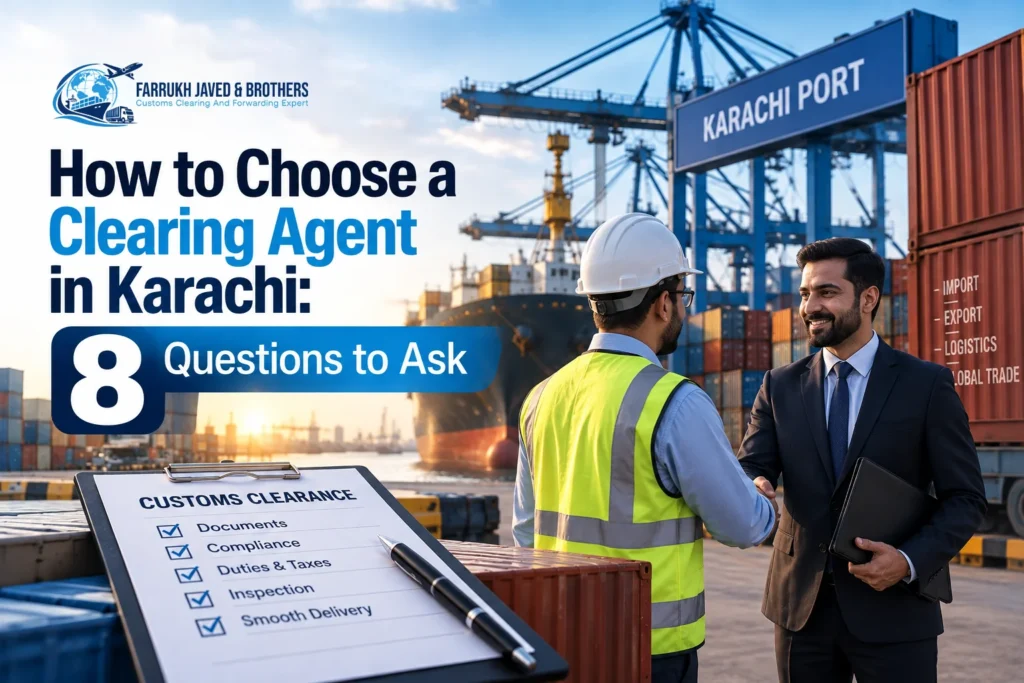
This guide explains how to choose a clearing agent in Karachi, and gives you eight questions to ask before you decide.
What Does a Clearing Agent Do?
A clearing agent, also called a customs agent, handles the paperwork and coordination needed to get your goods cleared through customs. This usually includes:
- Checking your shipping documents
- Preparing and filing the Goods Declaration (GD) in WeBOC
- Coordinating duty and tax payments
- Dealing with customs officers if goods are selected for examination
- Coordinating with shipping lines, terminals, and transporters
- Keeping you updated until the cargo is released
A good agent does more than file forms. They help you avoid mistakes that cause delays.
Question 1: Are You Licensed and Registered?
Start with the basics. A clearing agent filing declarations on your behalf should hold a valid customs agent licence and be registered in the WeBOC system.
Ask for details, and confirm them independently where possible. A genuine agent will not mind being asked.
Question 2: Do You Have Experience With My Type of Cargo and Port?
Clearing a container of textiles is different from clearing machinery, food products, chemicals, or project cargo. Ports and terminals in Karachi, such as Karachi Port, Port Qasim, and others, also have their own working practices.
Ask how often they handle goods like yours and which terminals they work with.
Question 3: What Exactly Is in Your Charges?
This is where many surprises happen. A clear quote should separate:
- The agent’s own service fee
- Government duties and taxes
- Port, terminal, and shipping line charges
- Transport and delivery
- Anything that may be added later
Ask for a written breakdown. A very low quote can be a warning sign if it leaves out items that you will have to pay later.
Question 4: Who Will Handle My File?
Some companies have a sales person at the front and a different team behind the scenes. Ask who will actually work on your shipment and whether you can speak to them directly.
A single point of contact saves you from explaining your situation again and again.
Question 5: How Will You Keep Me Updated?
Silence is stressful when your cargo is sitting at the port. Ask how updates are shared, by phone, WhatsApp, or email, and how often.
You want an agent who tells you what is pending and what happens next, in plain language, without technical jargon.
Question 6: What Do You Check Before the Cargo Arrives?
The best time to catch a problem is before the shipment lands. Ask whether the agent reviews your invoice, packing list, bill of lading, and HS codes in advance.
Early review helps avoid many common delays. Our guide on customs clearance delays covers the most common ones.
Question 7: What Happens If Something Goes Wrong?
Shipments can be selected for examination, documents can be questioned, and unexpected issues can appear. Ask how the agent handles these situations.
- Will they inform you immediately?
- Will they attend the examination?
- Who decides on the next step?
- How do they help you avoid extra port charges?
Their answer will tell you a lot about how they work under pressure.
Question 8: Can You Share References or Past Work?
Ask about the types of clients and shipments they have handled. Speaking to an existing client, where possible, can give you a more honest picture than any brochure.
Also check that they have a proper office, a clear address, and contact details you can verify.
Red Flags to Watch For
- Promises of guaranteed clearance times or “no delays”
- A quote that seems far lower than everyone else’s, with no written breakdown
- Reluctance to share licence or registration details
- Pressure to decide immediately
- No office address or unclear company details
- Unclear answers about who is responsible if there is a problem
Individual Agent or Larger Company?
Both can work. An individual agent may offer personal attention. A larger company may offer more services, such as freight forwarding, warehousing, transport, and documentation support under one roof.
Choose based on your needs. If you have a regular flow of shipments or several services to manage, a company that can coordinate everything may save you time.
What to Prepare Before Your First Call
- Description of your goods and HS code, if you know it
- Port or airport of arrival
- Shipment type (sea, air, container size)
- Expected arrival date
- Copies of commercial invoice, packing list, and bill of lading, if available
- Any permits or approvals needed for your product
The more information you share, the more accurate the answers you get.
Frequently Asked Questions
What does a clearing agent do?
A clearing agent prepares and files customs documents, coordinates payments and examinations, and helps release your goods from the port.
How much does a clearing agent charge?
It depends on the shipment, the type of goods, and the services you need. Always ask for a written breakdown of fees and third-party charges.
Do I need a clearing agent to import goods?
Many importers use one because customs procedures are detailed and mistakes can be costly. Check current requirements with Pakistan Customs or a licensed agent.
What is the difference between a clearing agent and a freight forwarder?
A clearing agent mainly handles customs clearance. A freight forwarder arranges the movement of goods. Some companies offer both.
Can I change my clearing agent later?
In many cases, yes, but it is easier to choose carefully at the start.
Do customs rules change?
Yes. Procedures and requirements can be updated, so always confirm current rules before you ship.
Final Thoughts
The right clearing agent is not the cheapest or the one with the loudest promises. It is the one who is licensed, experienced with your cargo, clear about costs, and open about how they work.
Take a few minutes to ask these eight questions before you commit. It can save you far more time and money later.
At Farrukh Javed & Brothers, we have more than 20 years of experience in customs clearance and freight forwarding in Karachi. If you would like to discuss your next shipment, talk to our logistics team or learn more about our customs clearance services.